15 Cozy Mini Coffee Bar Ideas for Tiny Homes

Look, I get it. You’re living in a shoebox-sized apartment, and the thought of dedicating an entire corner to a coffee bar seems about as realistic as fitting a king-sized bed in there. But here’s the thing—you absolutely refuse to give up your morning coffee ritual just because your home could fit inside someone else’s walk-in closet.
I’ve been there, trust me. When I downsized from a sprawling house to a 450-square-foot studio, I thought my coffee bar dreams were toast. Spoiler alert: they weren’t. After months of experimenting, rearranging, and honestly getting way too creative with vertical space, I discovered that tiny homes and coffee bars can totally coexist. You just need to think outside the box—or in this case, think really small boxes.
So grab your favorite mug (the one you’re probably drinking from right now), and let’s walk through 15 genuinely clever mini coffee bar ideas that won’t make your tiny home feel like a cluttered mess. These aren’t your typical Pinterest-perfect setups that require a construction crew. These are real, doable solutions for real people with real space constraints.
Corner Shelf Mini Coffee Bar
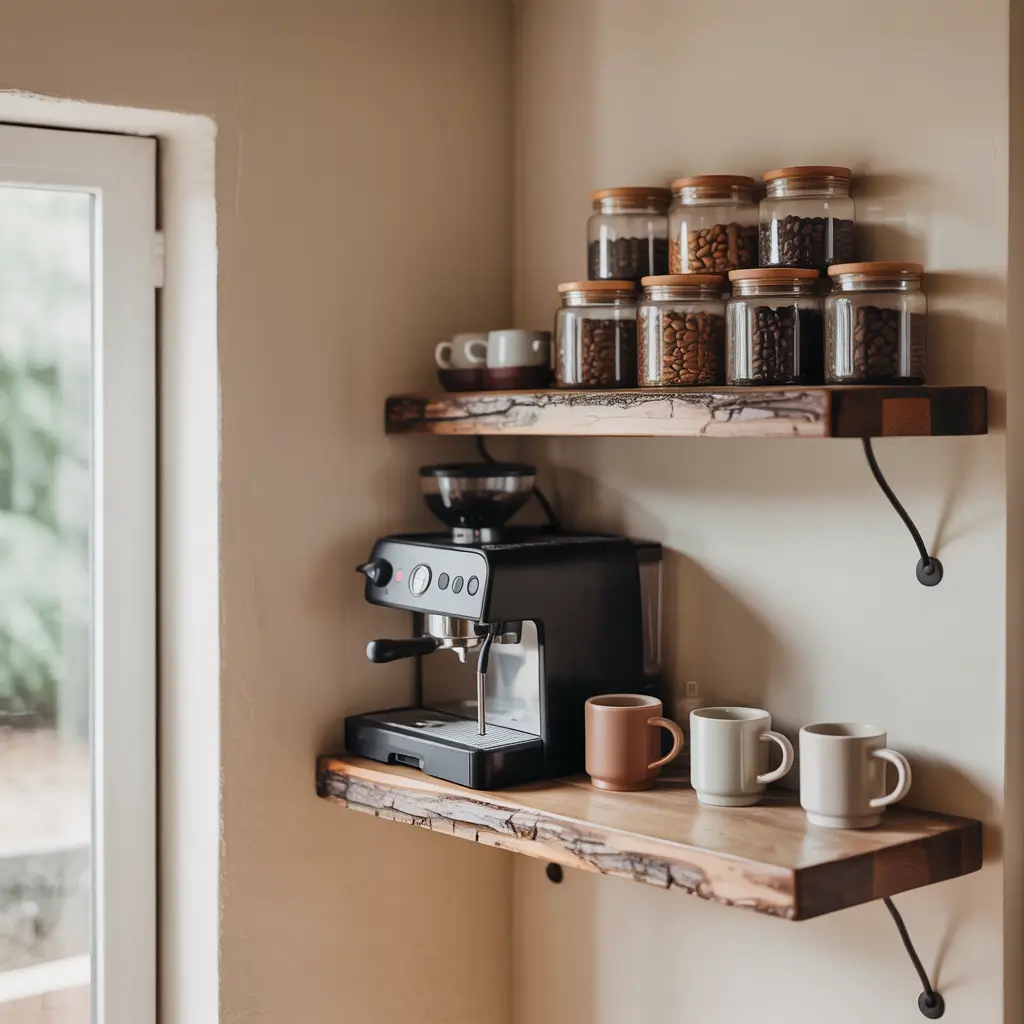
Ever notice how corners just sit there doing absolutely nothing? Like, they’re the laziest part of any room. Well, time to put them to work.
Corner shelves are honestly genius for tiny home coffee bars. You can snag a two or three-tier corner shelf for like twenty bucks, and suddenly you’ve got dedicated coffee real estate without sacrificing any usable wall space. I set mine up in my kitchen corner, and it holds my coffee maker on the bottom shelf, mugs on the middle, and all my fancy syrups and sweeteners on top.
The beauty of this setup is that it utilizes dead space that you probably weren’t using anyway. Plus, corner shelves come in tons of styles—rustic wood, sleek metal, even bamboo if you’re feeling eco-friendly. You can customize it to match whatever aesthetic you’re going for.
Pro tip: Get a lazy Susan for the top shelf. Seriously, it’s a game-changer when you need to grab that caramel syrup hiding in the back. No more knocking over everything else in the process.
Rolling Cart Coffee Station
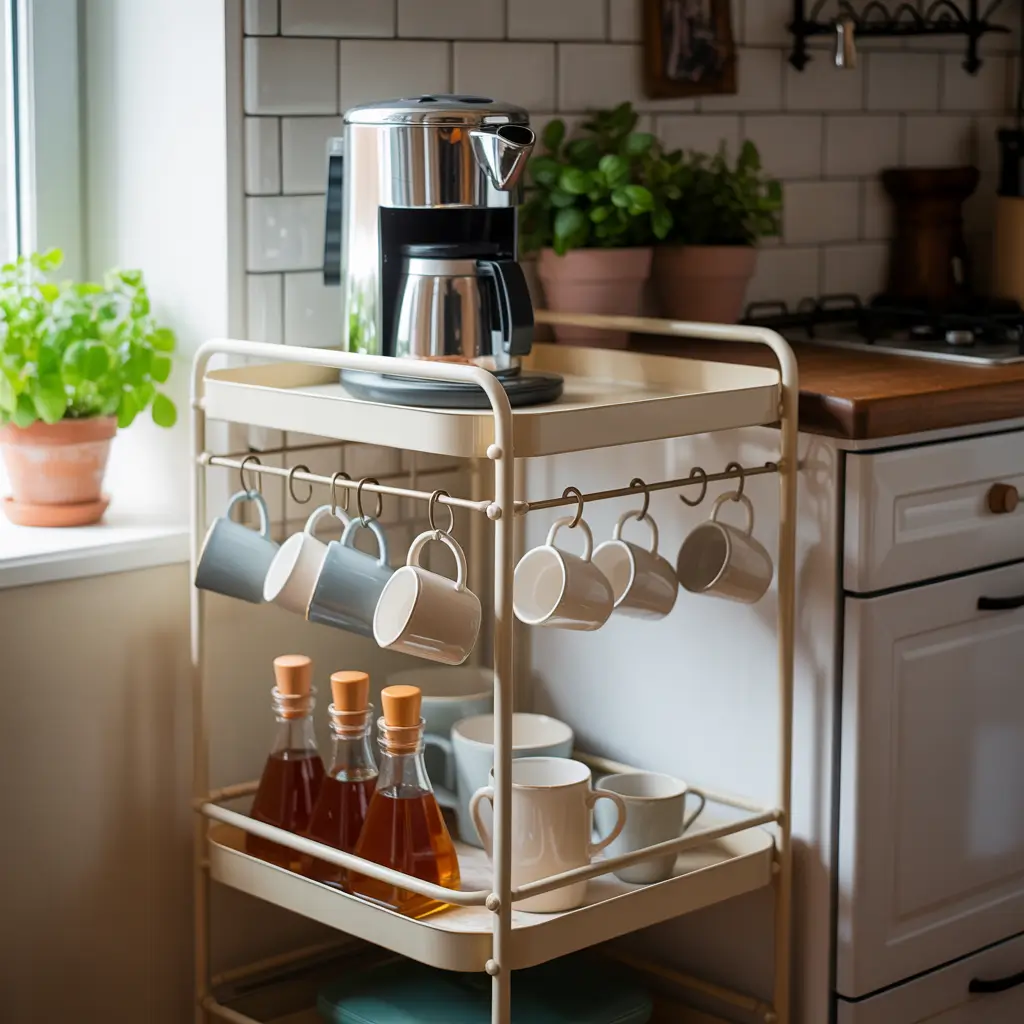
Okay, so this one’s my personal favorite, and here’s why: flexibility. Some days you want your coffee bar in the kitchen. Other days, maybe you’re working from your bedroom and want it right there next to your desk. A rolling cart gives you options, and when you’re living in a tiny space, options are everything.
I bought a three-tier rolling cart (you know, one of those IKEA-style ones everyone has), and it’s become my coffee station MVP. The top tier holds my espresso machine, the middle one stores my coffee beans and grinder, and the bottom is home to all my random coffee accessories—filters, stirrers, that milk frother I use maybe twice a month.
The wheels mean I can tuck it away in a corner when I’m not using it, or roll it into the living room when I’m entertaining. It’s like having a portable coffee shop. Plus, most rolling carts have handles or rails on the sides, which means nothing’s sliding off when you move it around.
What to look for:
- Sturdy wheels (at least one set should lock)
- Metal construction if you’re putting anything heavy on it
- At least three tiers for maximum storage
- A top surface large enough for your coffee maker
Countertop Tray Coffee Bar
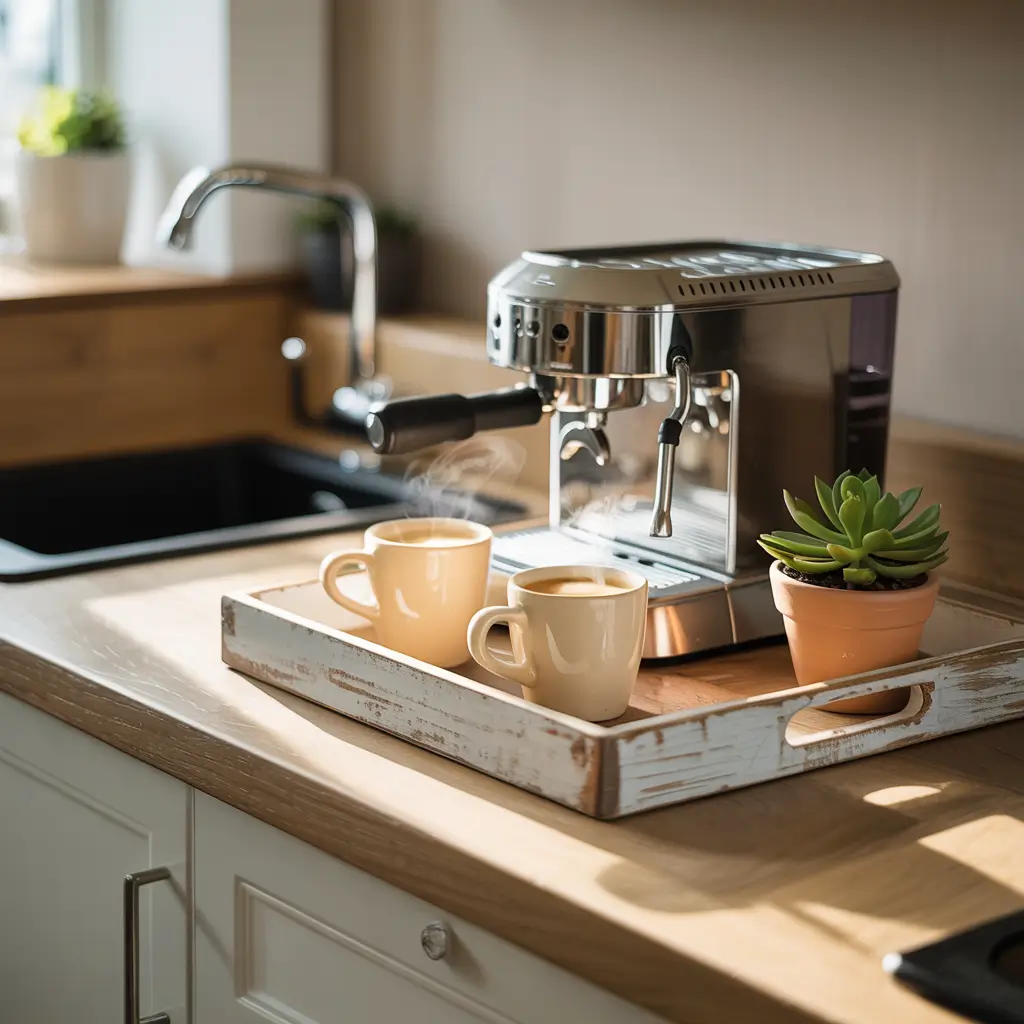
Sometimes the simplest solutions are the best ones. If you’ve got even a tiny bit of counter space—we’re talking like 12 inches—you can create a coffee bar with just a decorative tray.
This is basically the minimalist’s dream setup. You grab a stylish tray (wood, marble, whatever floats your boat), and you corral all your coffee essentials onto it. Coffee maker, sugar bowl, maybe a small plant because we’re not animals. The tray creates a defined “zone” for your coffee stuff, which psychologically makes it feel like an actual coffee bar rather than just clutter on your counter.
I love this approach for people who don’t have a ton of coffee gear. If you’re a simple drip coffee person or you use a French press, this is perfect. Everything stays contained and organized, and when you need your counter space back, you can literally just move the entire tray somewhere else.
The key is choosing a tray that’s both functional and pretty. It’s going to be sitting out on your counter all the time, so make it count. I’ve seen people use vintage serving trays, modern acrylic ones, even repurposed cutting boards. Get creative!
Wall-Mounted Mug Rail Coffee Bar
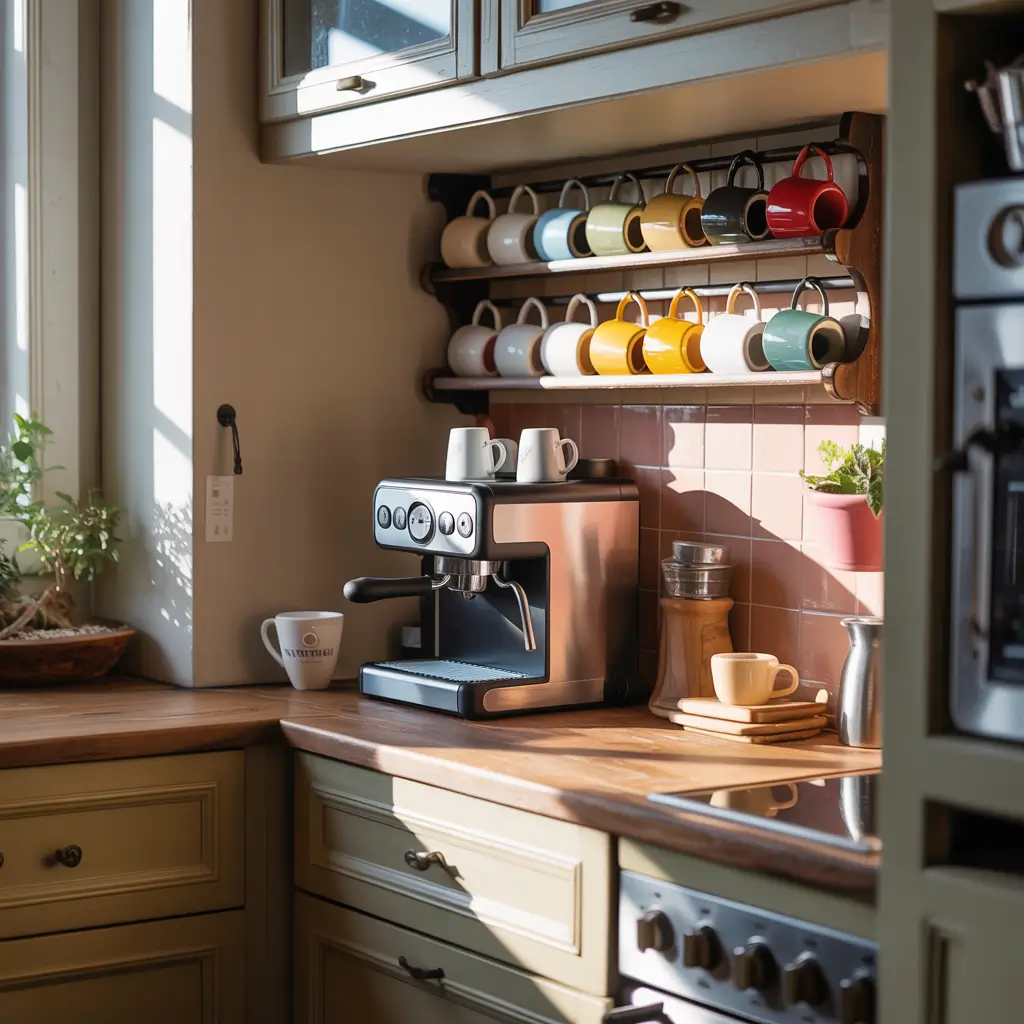
Here’s a wild concept: walls are prime real estate that most people completely ignore. A wall-mounted mug rail maximizes vertical space while keeping your mugs accessible and honestly kind of Instagram-worthy.
You mount a simple rail or rod to your wall (ideally near where you make coffee), add some S-hooks, and boom—you’ve got mug storage that doubles as decor. Below the rail, you can add a small floating shelf for your coffee maker and supplies. The whole setup takes up maybe 18 inches of wall space but gives you a fully functional coffee bar.
I installed one of these above my countertop, and it freed up so much cabinet space. Plus, I actually use more of my mug collection now because I can see them. Before, my favorite mugs were buried in the back of a cabinet, and I’d just use the same boring one every day.
Installation tips:
- Use proper wall anchors if you’re not hitting studs
- Keep the rail at a height where you can easily reach the mugs
- Don’t overload it—mugs are heavier than you think
- Consider adding a second rail if you’re a serious mug collector 🙂
Floating Shelf Coffee Nook
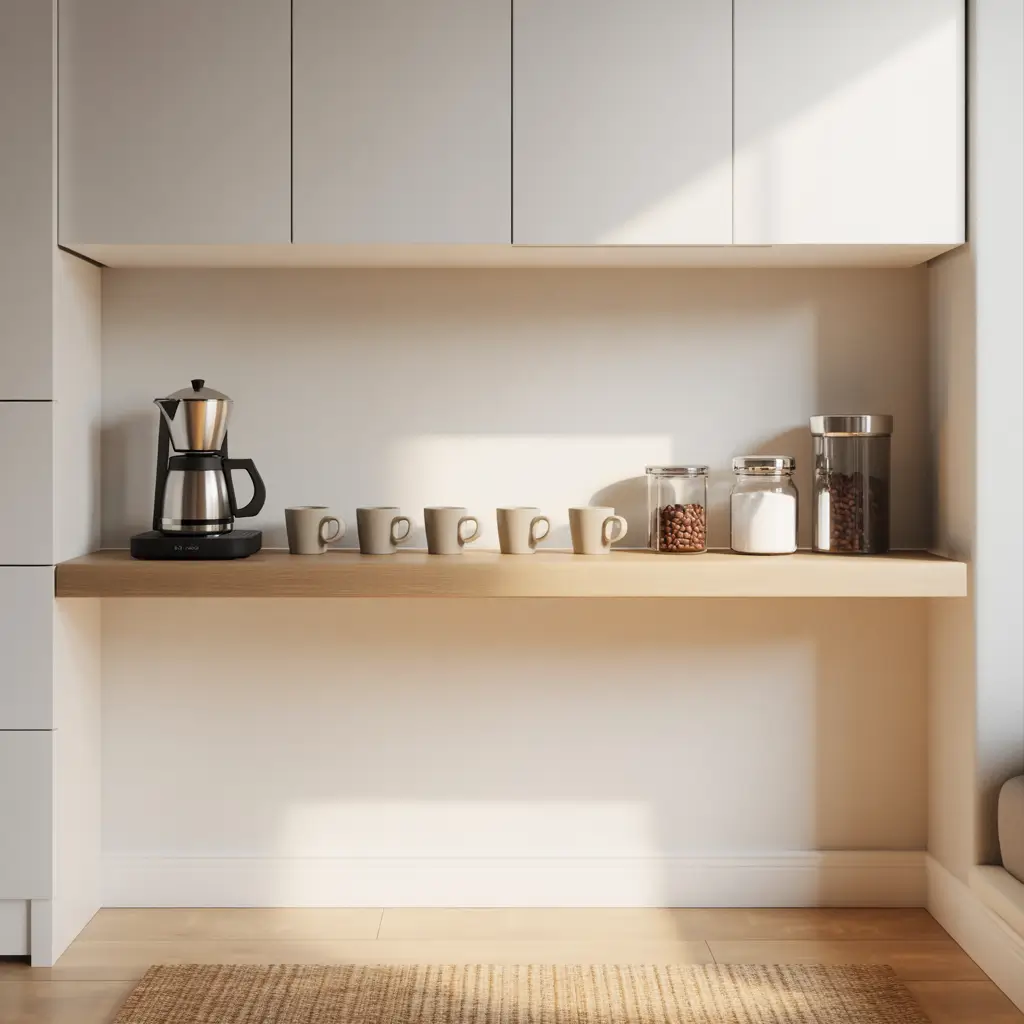
Floating shelves are the chameleons of tiny home furniture. They look sleek, they don’t take up floor space, and you can install them literally anywhere you’ve got a spare bit of wall.
For a coffee nook, you want at least two floating shelves stacked vertically. The bottom shelf holds your coffee maker (make sure it’s deep enough and sturdy enough for the weight), and the top shelf is for storage—coffee beans, filters, mugs, whatever you need. Some people add a third shelf for extra storage or decorative elements.
The cool thing about floating shelves is they feel way less bulky than traditional shelving. They almost disappear into the wall, which is exactly what you want in a tiny home. I’ve got mine set up in a narrow space between my fridge and the wall—like a 10-inch gap that was totally wasted before.
You can customize the look completely. Want rustic farmhouse vibes? Get chunky wood shelves. Prefer modern minimalism? Go with white or black floating shelves. You can even find ones with built-in lighting if you’re feeling fancy.
Also Read: 15 Vibrant Coffee Bar Aesthetic Designs for Artistic Homes
Cabinet Door Coffee Bar Setup
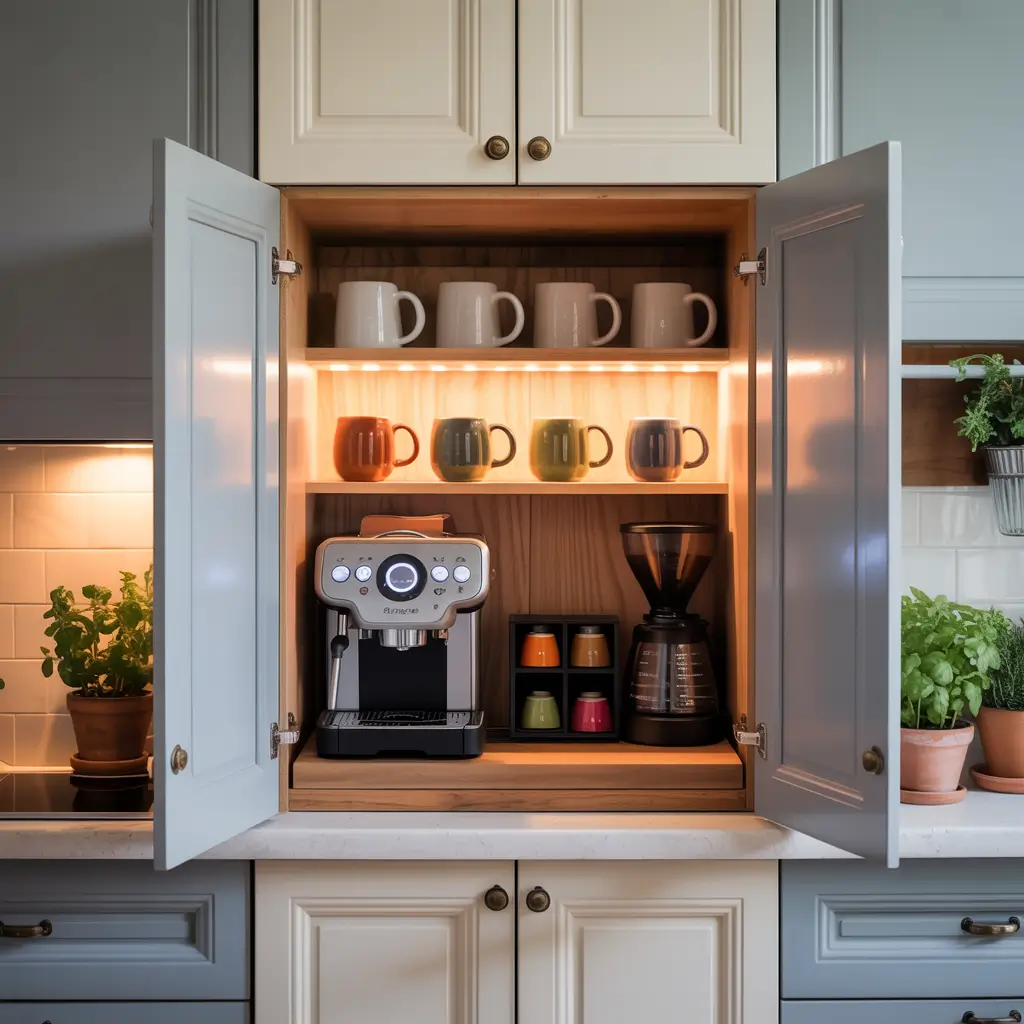
This idea is sneaky-smart. You know that empty space on the inside of your cabinet doors? Yeah, that’s about to become your new coffee bar.
You can attach hooks, small baskets, or even tiny shelves to the inside of a cabinet door. Use it to store coffee pods, tea bags, stirrers, sugar packets—all those small items that usually create clutter. Then keep your coffee maker on the counter or shelf right next to that cabinet, and you’ve got a hidden storage coffee bar that barely takes up any visible space.
I use this setup for my K-cup collection (judge me all you want, they’re convenient). I attached a wire rack to the inside of my cabinet door, and it holds about 20 K-cups. Right below, I keep my Keurig on the counter. Everything I need is within arm’s reach, but when I close the cabinet door, you can’t see any of the storage mess.
What you can attach to cabinet doors:
- Wire racks for coffee pods
- Small baskets for tea bags and sweeteners
- Hooks for measuring spoons and small utensils
- Cork board for coffee recipes or grocery lists
Narrow Console Table Coffee Bar
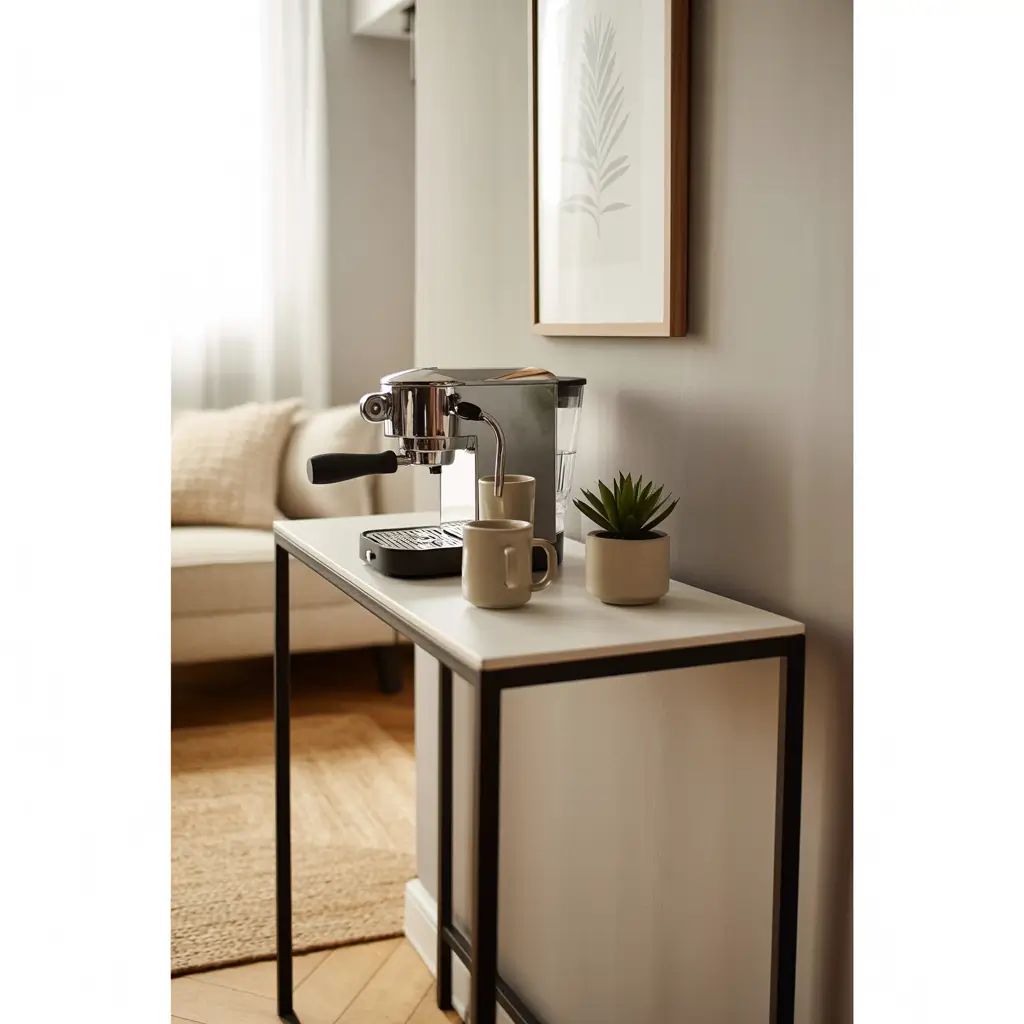
Got a hallway or a narrow strip of wall space? A slim console table might be your coffee bar solution. We’re talking those super narrow tables that are like 8-10 inches deep.
These tables are perfect because they’re specifically designed for tight spaces. You can tuck one against a wall in your entryway, hallway, or even behind your couch if you’ve got an open floor plan. Put a compact coffee maker on top, and use baskets underneath for storage.
I’ve seen people create absolutely gorgeous coffee bars with console tables. The narrow profile means they don’t intrude into your walking space, but they still give you that dedicated coffee station feel. Plus, console tables often come with a shelf or two underneath, which is perfect for storing extra supplies, mugs, or that bread maker you swore you’d use more often.
The trick is measuring your space carefully. You need enough depth for whatever coffee maker you’re using—most need at least 10-12 inches. And make sure you’ve got clearance above for opening the water reservoir and such.
Vertical Ladder Shelf Coffee Bar
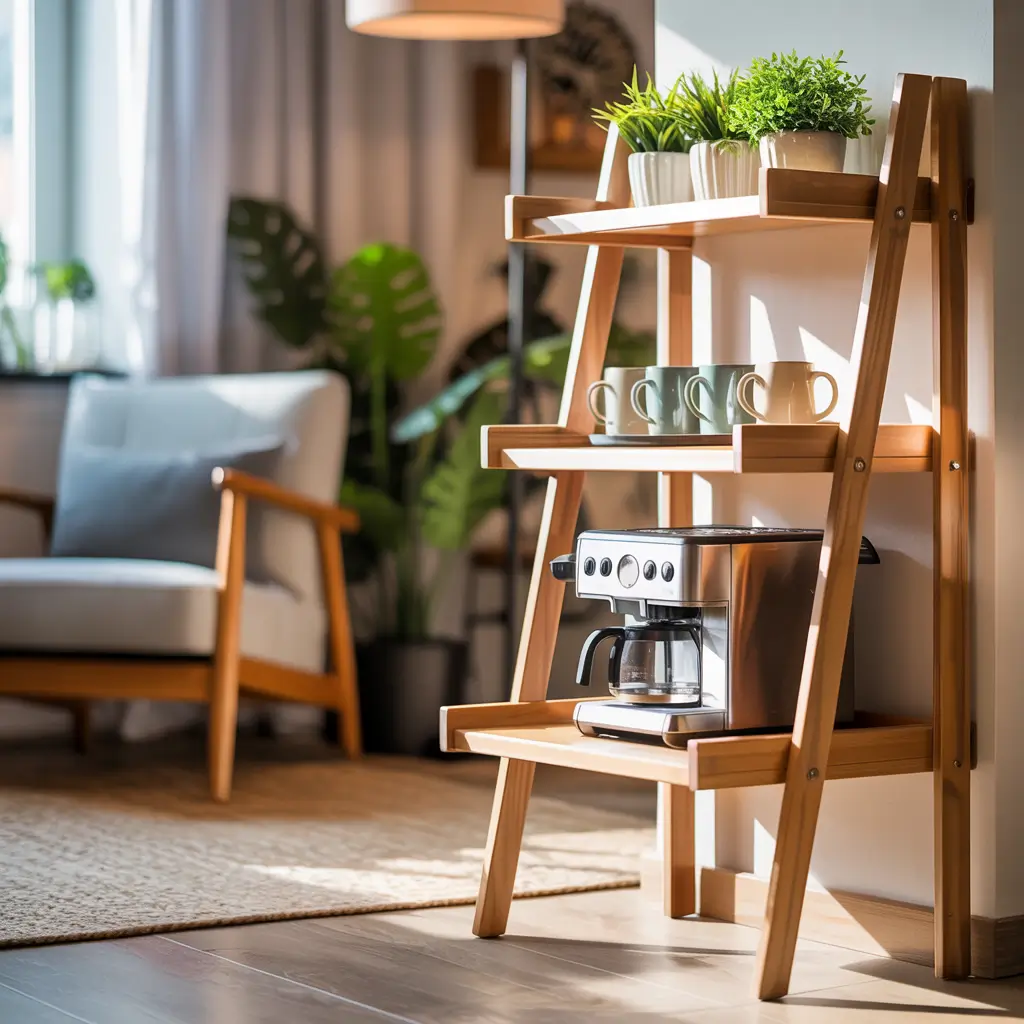
Ladder shelves are having a moment, and honestly, I’m here for it. They lean against the wall, they look cool and casual, and they give you multiple tiers of storage without the bulk of traditional shelving units.
For a coffee bar setup, you use the wider bottom shelf for your coffee maker and the upper shelves for mugs, coffee beans, and decorative stuff. The angled design actually makes everything super accessible—you’re not reaching into deep cabinets or struggling to see what’s on the back of a shelf.
I love ladder shelves because they feel less permanent than mounted shelving. You can move them around without leaving holes in your walls, which is clutch if you’re renting. Plus, the open design keeps your space feeling airy, which is crucial when you’re working with limited square footage.
Choosing the right ladder shelf:
- Look for one with at least 4 shelves
- Make sure the bottom shelf is wide and sturdy enough for your coffee maker
- Wood ones are generally sturdier than metal for holding weight
- Consider the angle—some lean more dramatically than others
Coffee Bar in a Drawer
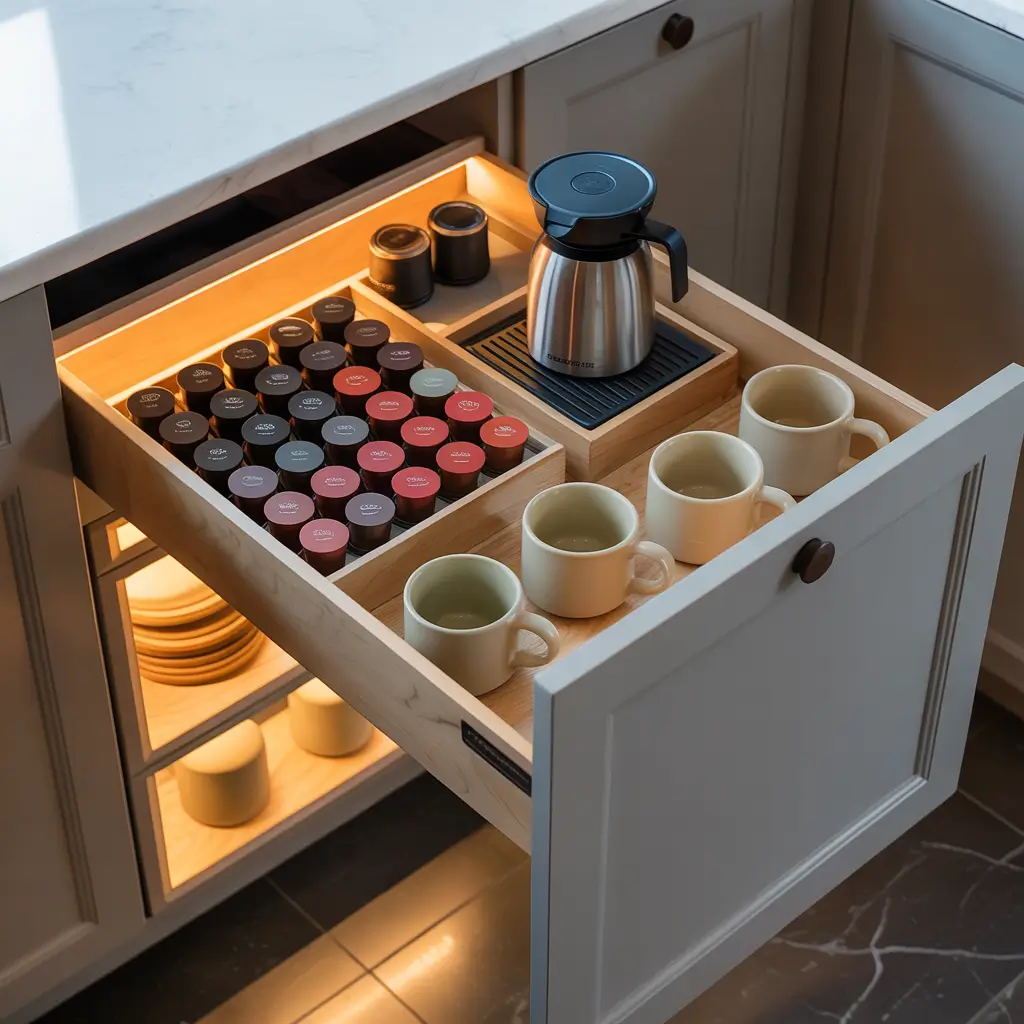
Okay, this one sounds weird, but hear me out. If you’ve got a deep drawer in your kitchen, you can convert it into a pull-out coffee station. I know, I know—sounds complicated. But it’s actually pretty straightforward and incredibly space-efficient.
The basic idea is this: you keep your coffee maker and supplies inside a drawer. When you want coffee, you pull the drawer out, make your coffee, and push it back in. Some people even drill a small hole in the back of the drawer for the coffee maker cord so they can keep it plugged in.
This setup is perfect for people who want their coffee stuff completely hidden when not in use. Your kitchen looks clean and minimal, but you’ve still got a fully functional coffee station ready to go. IMO, it’s one of the cleverest space-saving solutions out there.
The main requirement is having a drawer that’s deep enough and sturdy enough to hold a coffee maker. You’ll also want to line the drawer with a non-slip mat so nothing slides around when you open and close it. And obviously, if you’re drilling holes for cords, make sure you’re okay with modifying your furniture.
Minimalist One-Shelf Coffee Bar
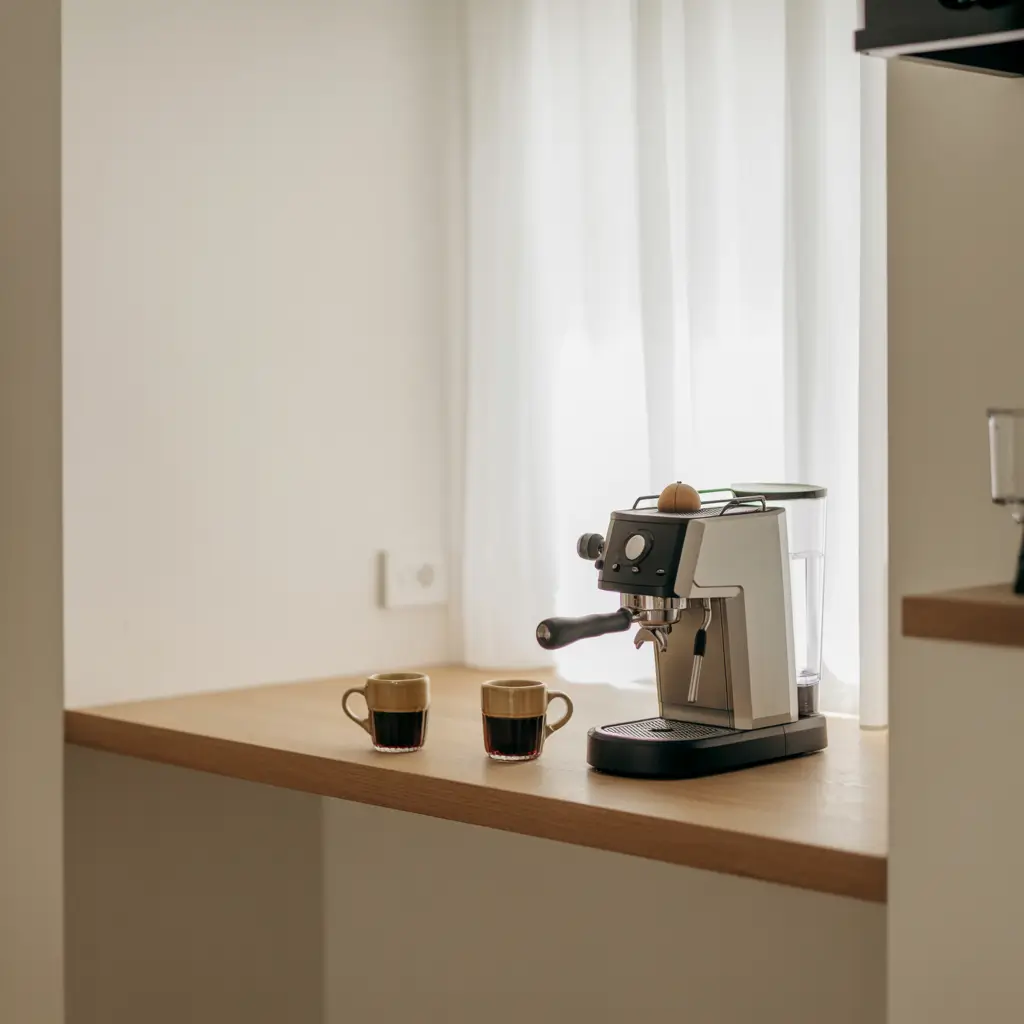
Sometimes you really don’t need much. If you’re a coffee purist who just uses a pour-over or French press, a single floating shelf might be all you need.
Mount one shelf to your wall at a comfortable working height. Keep your kettle, coffee beans, and your brewing device on it. Maybe add a small container for filters or a grinder. That’s it. You’ve got a coffee bar. Simple, clean, and it takes up maybe 16 inches of wall space.
I used this exact setup in my first tiny apartment, and it was honestly perfect. I had a simple electric kettle, my pour-over cone, a jar of coffee beans, and two mugs. Everything lived on one 20-inch shelf. It looked intentional and stylish rather than cramped.
The minimalist approach forces you to be choosy about what you actually need. Do you really need 47 different coffee syrups? Probably not. The one-shelf rule makes you pare down to essentials, which is kind of liberating in a weird way.
Under-Cabinet Mini Coffee Bar
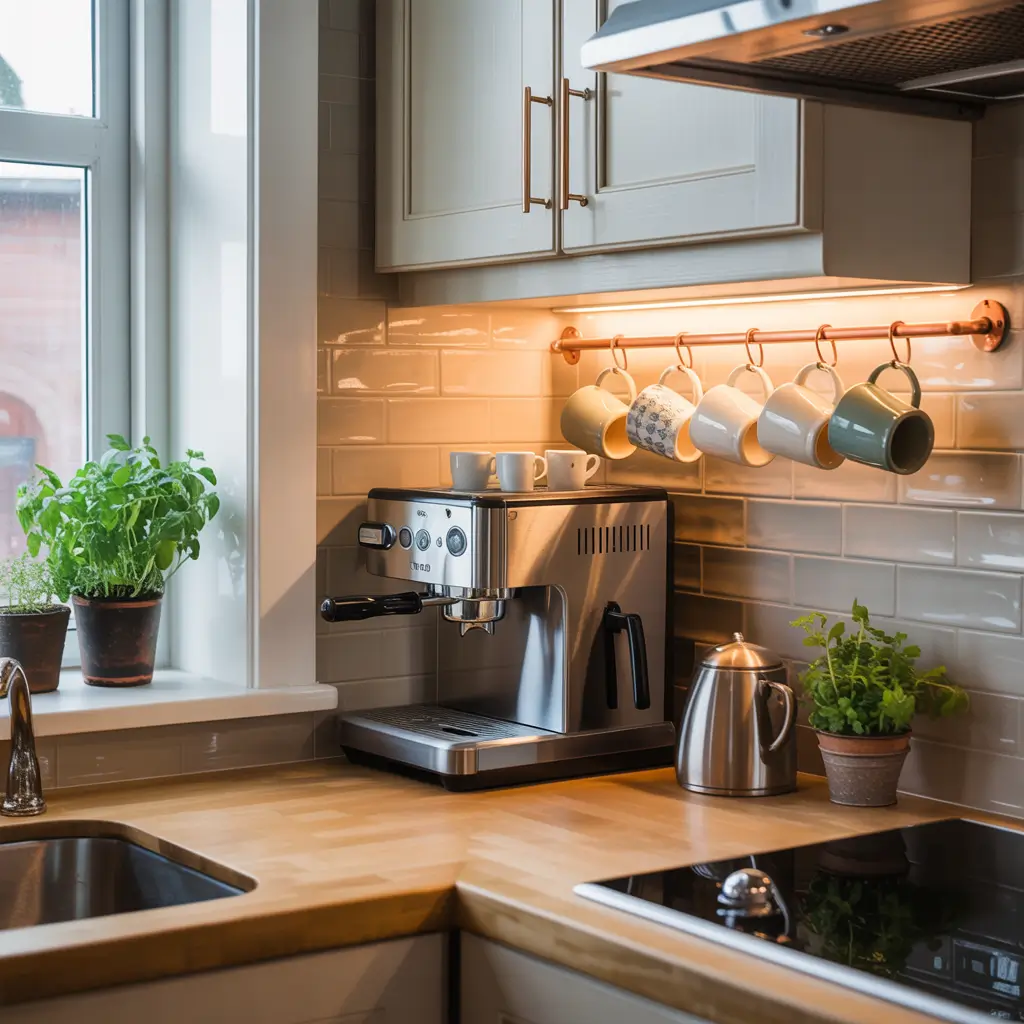
The space underneath your cabinets is super underutilized in most kitchens. You can mount things under there—we’re talking about the underside of your upper cabinets, not the lower ones, just to be clear.
You can install under-cabinet hooks for hanging mugs, or even mount a small shelf under there for coffee pods and small supplies. Pair this with a small coffee maker on the counter directly below, and you’ve got a compact coffee station that uses vertical space brilliantly.
Some people get really fancy and mount their coffee maker itself under the cabinet using special brackets. This completely clears your counter space but keeps your coffee maker accessible. I haven’t personally done this (I’m lazy and it seems complicated), but I’ve seen setups that look amazing.
Under-cabinet options:
- Mug hooks or rails
- Small mounted baskets for supplies
- Paper towel holder (useful for spills)
- Mounted coffee pod dispenser
- Lighting strips to brighten your workspace
Also Read: 15 Beautiful Coffee and Wine Bar Ideas to Try Now
Coffee Bar on a Bar Cart
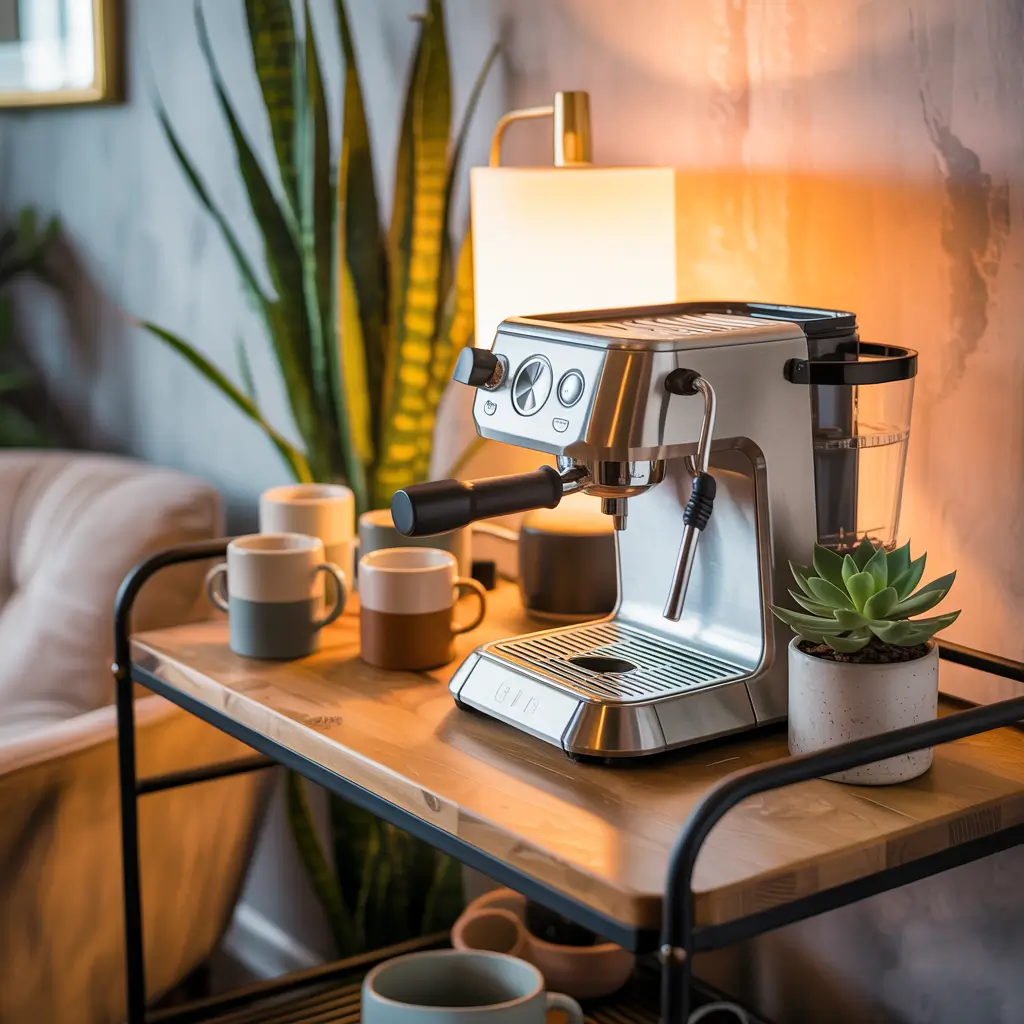
Wait, didn’t I already talk about rolling carts? Kind of, but bar carts deserve their own mention because they’re specifically designed to look good while holding your beverages and related accessories.
Bar carts are usually prettier than utility rolling carts. They come in gold finishes, rose gold, brass, wood with metal accents—basically, they’re designed to be decorative furniture pieces. For a coffee bar, this means you get functionality and style.
I upgraded from my basic rolling cart to a proper bar cart, and it honestly elevated my whole space. Same functionality—wheels, multiple tiers, portability—but it looks like intentional décor rather than dorm room furniture. When friends come over, the bar cart coffee station becomes a conversation piece.
The downside is bar carts are usually pricier than basic rolling carts. But if aesthetics matter to you (and in a tiny home, everything’s on display, so maybe they should?), it’s worth the investment. Plus, you can always repurpose it as an actual bar cart later. Versatility, baby.
Coffee Bar in a Pantry Nook
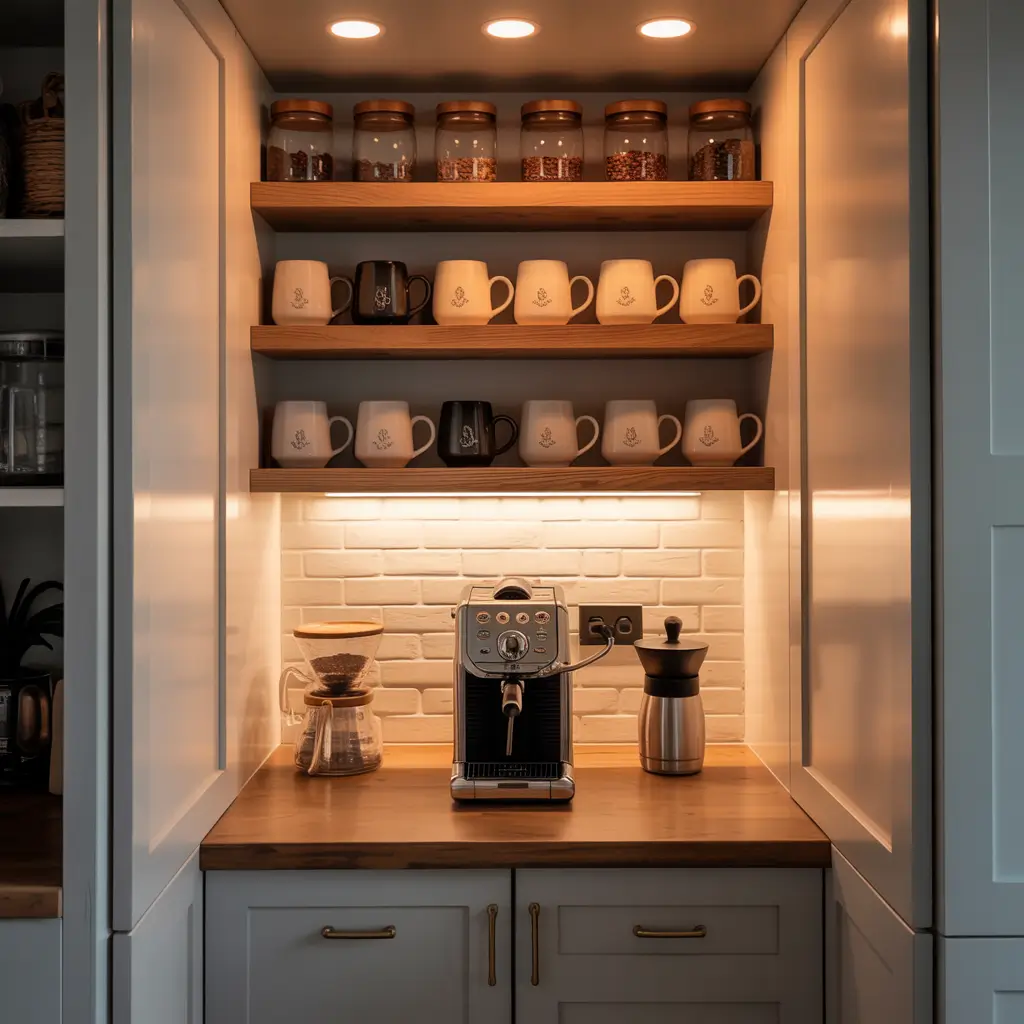
If you’ve got a pantry—even a small one—you might be able to carve out a little coffee nook in there. I’m talking about dedicating one shelf or section specifically to coffee.
This works especially well if you’ve got a walk-in pantry (however small). You can put a small shelf in there with your coffee maker, keep your supplies organized around it, and basically have a hidden coffee station. You open the pantry, make your coffee, and close the door. Everything’s contained and out of sight.
Even if you don’t have a walk-in situation, you might be able to work with what you’ve got. Some people remove a shelf from a regular pantry cabinet and create a little pull-out station. It requires a bit more DIY skill, but the end result is pretty slick.
The pantry approach keeps your kitchen looking uncluttered while still giving you quick access to coffee. Plus, storing coffee beans in a pantry (which is hopefully dark and cool) is actually better for keeping them fresh. So you’re being practical and space-savvy. Win-win.
Fold-Down Wall Coffee Bar
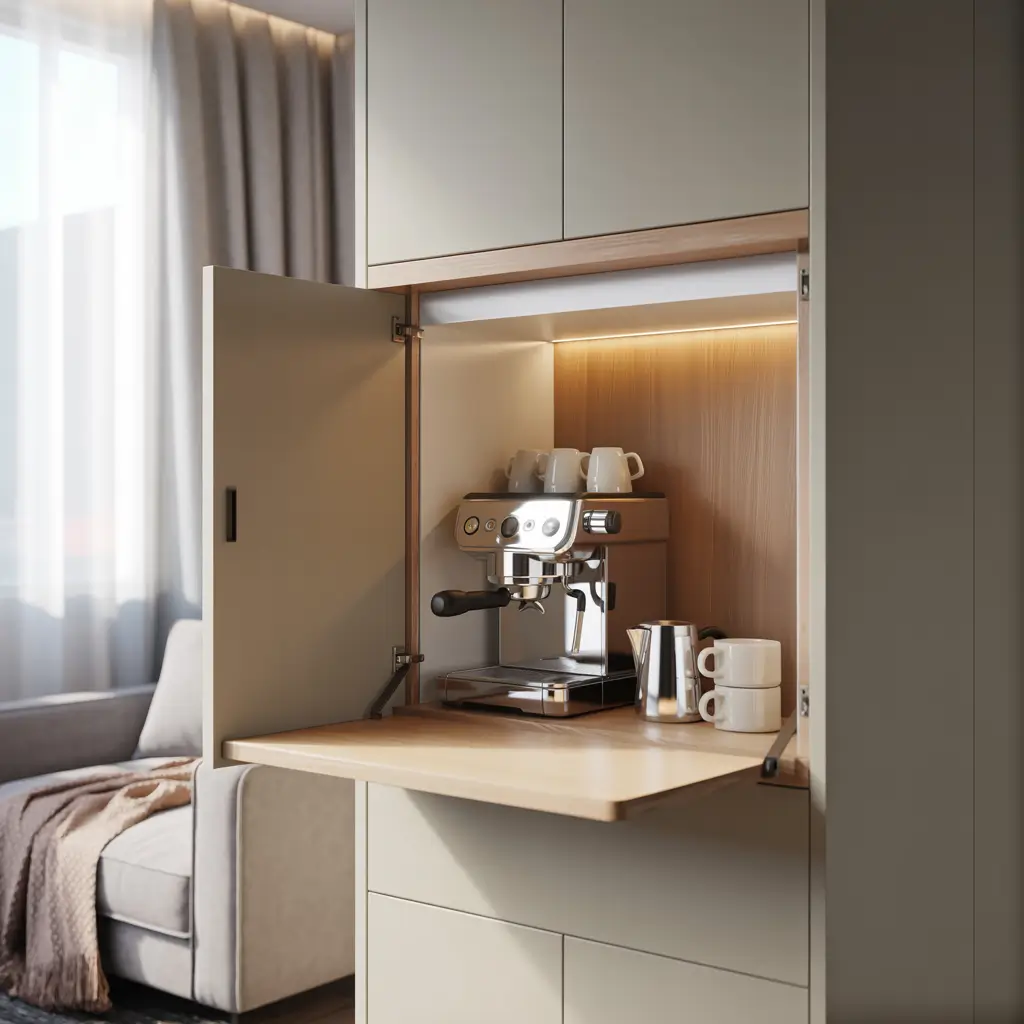
This is next-level space-saving, and I’m kind of obsessed with the concept. A fold-down wall coffee bar is basically a mounted shelf or table that you can fold up against the wall when not in use.
When you want coffee, you fold it down, and it creates a little workspace for your coffee maker and supplies. When you’re done, you fold it back up, and it’s flush against the wall—totally out of the way. Some designs even have storage built into the fold-down section for your coffee supplies.
FYI, this requires more installation effort than most options on this list. You’re essentially mounting a hinged shelf to your wall, and it needs to be really sturdy since it’ll be holding coffee maker weight. But if you’re handy or know someone who is, it’s an incredibly clever solution for tiny homes.
I’ve seen DIY tutorials for these, and they range from simple to elaborate. Some people add hooks underneath for mugs, or small shelves on the sides for storage. When it’s folded up, it can look like decorative wall art or a simple shelf. You’d never know there’s a whole coffee station hiding there.
Window Ledge Mini Coffee Bar
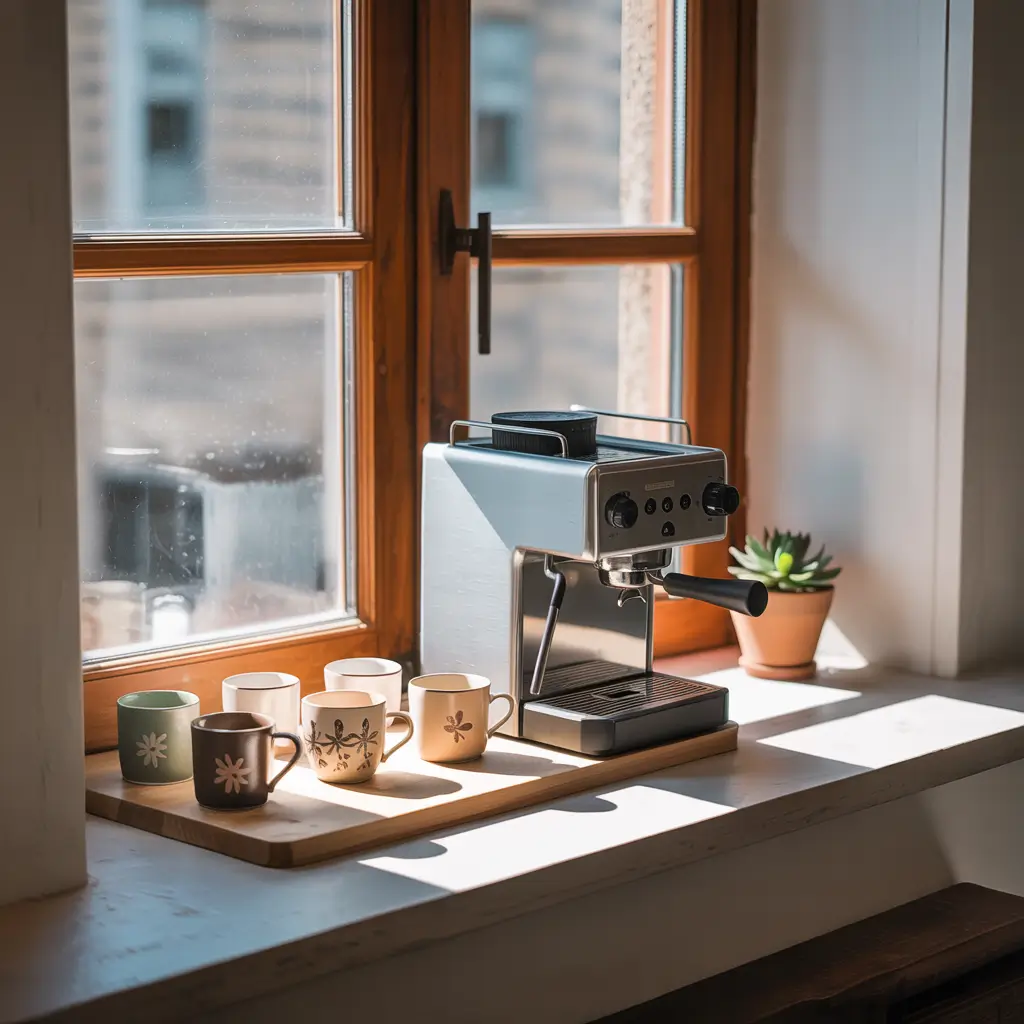
Last but definitely not least, let’s talk about window ledges. If you’ve got a deep window sill—maybe in your kitchen or even a sunny corner of your living room—you can turn it into a tiny coffee spot.
Obviously, this only works if your window ledge is deep enough and sturdy enough to hold a coffee maker. We’re probably talking at least 8-10 inches deep. But if you’ve got that, why not use it? You can keep a small coffee maker there, add a plant or two for ambiance, and enjoy making your morning coffee with natural light and a view.
I had a friend who did this in her studio apartment, and honestly, it was charming as hell. She’d make her pour-over coffee on the window ledge every morning while looking out at the street. It became her favorite part of the day. The setup was simple—just the window sill, no additional installation required—but it felt intentional and cozy.
Window ledge considerations:
- Make sure it can support the weight
- Keep cords tidy and away from the window opening
- Consider condensation issues if you’ve got old windows
- Sun exposure might affect coffee bean storage (use an opaque container)
- Enjoy the natural light and view while caffeinating!
Making Your Mini Coffee Bar Work for You
Here’s the thing about all these ideas: none of them are one-size-fits-all solutions. Your perfect coffee bar depends on your space, your coffee habits, and honestly, what kind of equipment you use.
If you’re a fancy espresso person with a massive machine, you’ll need more space and sturdier shelving than someone who just uses a French press. If you’ve got 47 different coffee syrups (no judgment, I see you), you need more storage than a black coffee minimalist. The point is to look at your actual needs and match them to your actual space.
When I first started planning my tiny home coffee bar, I made a list of everything I actually use on a daily basis. Turns out, it wasn’t as much as I thought. I was holding onto equipment “just in case” that I literally never used. Once I pared down to essentials, creating a functional coffee bar became way easier.
Questions to ask yourself:
- What coffee equipment do I actually use daily?
- How many mugs do I realistically need accessible?
- Do I need storage for multiple types of coffee, or am I a one-bag person?
- Am I willing to mount things to walls, or do I need movable solutions?
- How much am I willing to spend on this setup?
Final Thoughts: Small Space, Big Coffee Energy
Living in a tiny home doesn’t mean you have to sacrifice the things you love—including a dedicated spot for your coffee ritual. Whether you’re working with a corner shelf, a rolling cart, or getting creative with a fold-down wall station, there’s absolutely a solution that’ll work for your space.
I’ve tried probably half of these setups over the years (moving a lot will do that), and each one brought something different to the table. The rolling cart gave me flexibility. The floating shelves felt modern and clean. The window ledge setup made my mornings genuinely more pleasant. There’s no wrong answer here, just different approaches to the same goal: good coffee in a small space.
So pick one of these ideas—or combine a few if you’re feeling ambitious—and create your own cozy coffee corner. Your tiny home is small, but your coffee game doesn’t have to be. Now if you’ll excuse me, all this coffee talk has made me need another cup